
Port Orange Previous Resident Sources
A Port Orange address leaves different records in different eras. The current assessment roll gives the parcel identity and a starting owner. Recorded deeds create the ownership chain. A directory or census may identify occupants, while permits show when the property changed. No source proves every person in a household, so previous residents are best supported by two or more independent records.
| Source | Years covered | Where held | What it shows |
|---|---|---|---|
| VCPA assessment roll | Current roll; parcel history varies | Property Appraiser online | Owner, situs, mailing address, parcel key, exemptions and sales pointers |
| Clerk web index | April 4, 1988 to present | Official Records Inquiry | Grantors, grantees, date, instrument and book/page |
| Clerk research media | 1887 to present | DeLand courthouse | Earlier deeds on microfilm and digital media |
| Port Orange permits | Beginning year not published | SmartGov or city request | Applications, permits, inspections and parcel references |
| Directories and census | Runs vary; census public through 1950 | Libraries, archives and NARA | Address snapshots and named households |
| Probate and newspapers | Varies | Clerk and library databases | Heirs, relatives, notices and former addresses |
For recent Port Orange previous residents, start online. For a trail before the web index, plan on the courthouse, library, or archive. Exact local reverse-directory years have not been verified, so confirm a volume before depending on it.
Start Port Orange Previous Resident History
The strongest first stop is the Volusia County Property Appraiser Real Property Search. Search the street number and name, then save the Short Parcel or AltKey, situs address, owner name, legal description, and sales reference. Situs means the physical site. The mailing address is where the owner receives tax notices, and it may be elsewhere.
Those distinctions matter. A matching mailing address and homestead exemption can support owner occupancy, but they do not identify every past resident. A different mailing address may point to an owner who never lived at the Port Orange property. Renters and relatives often do not appear on the tax roll.
- Legal description
- The lot, block, subdivision, or land description that identifies a parcel without relying on its street number.
- Situs address
- The physical address assigned to the land, distinct from the owner's mailing destination.
- Parcel key
- A county identifier connecting maps, assessment data, sales, and other property records.
Note: Save the legal description first because it often survives changes in street numbering and municipal labels.
Follow Port Orange Previous Resident Deeds
The Volusia County Clerk Official Records index turns the current owner into a backward chain. Its name search is an alphabetical grantor and grantee index. A grantor transfers an interest; a grantee receives it. The chain of title is the linked sequence of those transfers for one parcel.
- Copy the present owner, parcel key, legal description, and latest sale reference from VCPA.
- Find that owner's purchase deed as grantee. Confirm the legal description, not just the name.
- Record the seller, instrument number, recording date, and book/page in the released index.
- Search that seller as an earlier grantee, then repeat the same check for each transfer.
- At the online cutoff, continue through the DeLand research media and original books.
A deed proves a recorded interest. It does not prove the grantee moved into the house. Life estates, trusts, family transfers, and corporate owners can all break a simple name-to-occupant assumption. Use directory, census, obituary, or homestead evidence before calling a deed party one of the previous residents.
Port Orange Records Before 1988
The online Official Records index begins April 4, 1988. Earlier Port Orange ownership research continues in Room A121 of the Volusia County Courthouse, 101 North Alabama Avenue in DeLand. Public Research microfilm and digital media reach 1887. Original books are available through Historical Records, and an appointment is recommended.
Staff can explain equipment but cannot conduct a title or lien search. Available online images may be printed free. Clerk copies cost $1 per page, and certification costs $2 per document. Requests also proceed in person, by mail, or through the Clerk's online contact route. These are distinct products: an index points to a record, an image shows the released instrument, and a certified copy is Clerk-issued.
The recorded deed access page explains the route shown below.
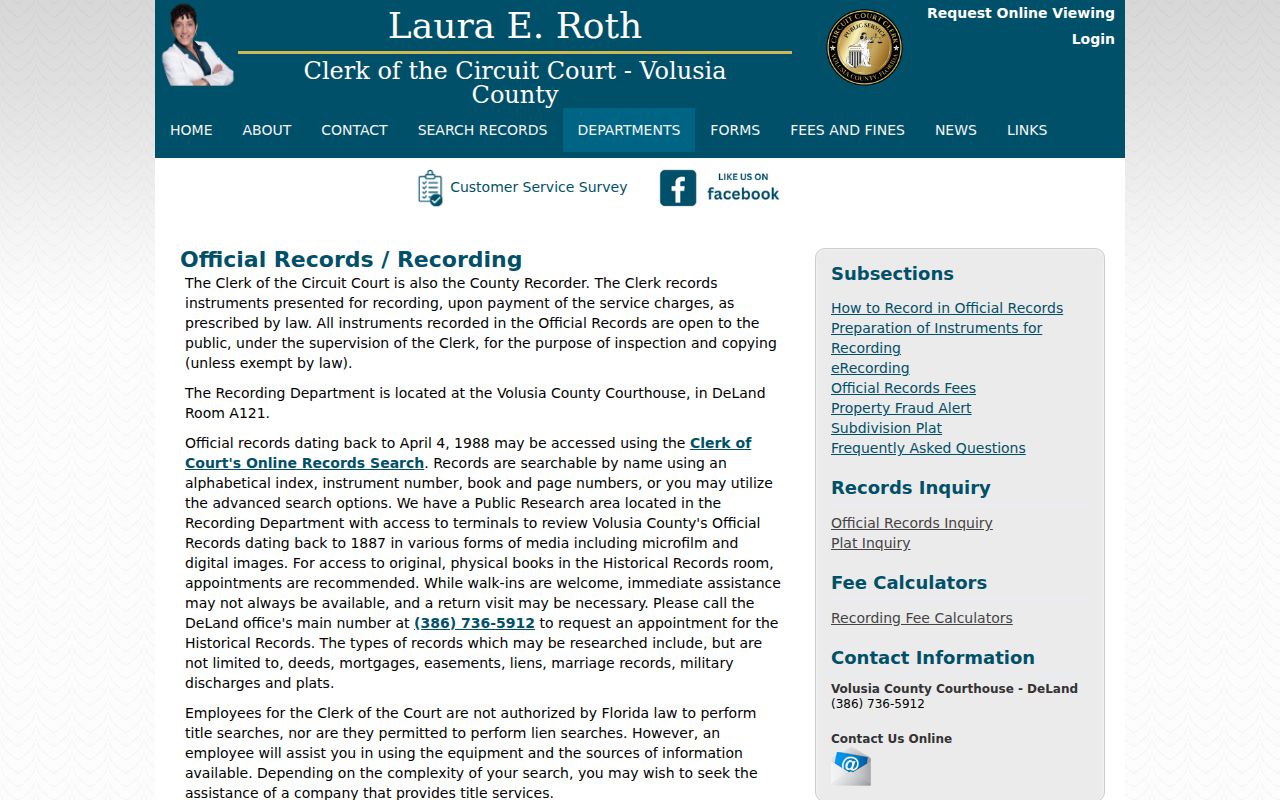
The captured Clerk page bridges online research and the older media held in DeLand.
Keep Port Orange Previous Resident Parcels
Street labels are poor long-term keys. Port Orange history includes Orange Port, Freemanville, Dunlawton, and land once in unincorporated Volusia County. Harbor Oaks and Allandale were later annexed. A house can gain a Port Orange label while an older permit or code file stays with the county custodian.
The parcel legal description is the continuity key. Match lot, block, subdivision, and deed description across each transfer. Plats can explain a split, combination, easement, or renamed subdivision. If a street number disappears from an older directory, search the subdivision, owner, nearby cross street, and historic place name.
Geography check. Determine which government had jurisdiction on the record date, not only which mailing city appears today.
Port Orange previous residents may appear under Halifax-area or Daytona regional titles. The 1867 name change and later annexations are search variables, not mere background.
Verify Port Orange Past Households
Ownership is only half the address history. Printed city and reverse directories can connect a street number to a listed householder or business. A criss-cross directory is arranged by address or telephone number rather than surname. Volusia County Public Library provides in-branch Ancestry Library Edition and HeritageQuest access, but exact Port Orange directory runs still need a shelf check.
- Place each deed owner on a year-by-year timeline.
- Check the closest directory before and after each recorded transfer.
- Pair directory years with the nearest public federal census, now available through 1950.
- Compare names, spouses, occupations, ages, and address context without assuming each match is one person.
- Record gaps and seek newspaper, probate, or permit support.
The Port Orange Directory Book page covers those collections. Here they serve one task: testing who lived at the parcel while ownership changed.
Port Orange Previous Resident Permits
Port Orange SmartGov describes address and parcel access to applications, permits, and inspections. These events can place a remodel, addition, pool, demolition, or new build on the house timeline. Yet an applicant may be the owner, contractor, or agent. A permit is not a household roster.
When the online search misses the needed year, request records from the Port Orange City Clerk. The city accepts requests by phone, email, in person, PDF request, or JustFOIA. Florida Public Records Law requires no special phrase or stated purpose for an ordinary request. Give the exact address, parcel key, date range, and permit or inspection type.
For an address outside city limits at the time, check Volusia County. Annexation can move current authority without moving an older file. Permit dates are strongest beside deeds and directory entries.
Close Port Orange Resident Trails
Probate, obituaries, and newspaper notices can explain why a name leaves an address trail. Volusia Clerk probate cases may identify a decedent, estate parties, heirs, or representative. FamilySearch catalog descriptions identify Volusia probate books for 1855 to 1872 and 1874 to 1922, plus a County Judge index from about 1855 to 1962. The 1873 break is an apparent collection gap, not proof no record exists.
Volusia County Public Library's research databases include the Daytona Beach News-Journal, historical DeLand material, HeritageHub, and other Florida sources. Search an exact address, spouse, subdivision, and historic place name. An obituary can tie relatives to a former Port Orange home, but compare it with deeds, directories, and probate.
This route helps with heir research. It joins a deed interest to a death endpoint and named family without treating one index hit as conclusive.
Port Orange Previous Resident Archives
No verified Port Orange-specific Sanborn map run or official house-history guide was found. Ask the Port Orange Regional Library at 1005 City Center Circle to verify reverse directories, telephone books, annuals, obituary tools, and maps. Reference staff can direct in-branch database use.
The Port Orange Historical Trust Museum at 740 Commonwealth Avenue collects photographs, postcards, letters, books, artifacts, and local stories. Its holdings are not a full public name index, but labeled photos or address files may solve a local gap. The State Library of Florida keeps city directories from the early 1900s onward, arranged by city and year, and can determine whether Port Orange appeared in a regional volume.
Federal census records use a 72-year release rule. The 1960 census is scheduled for release in 2032. Later occupancy work depends more on directories, press archives, property records, and lawful family sources.
Note: Call before traveling because local volume and map coverage lacks a complete published inventory.
Use Previous Resident Records Lawfully
Previous-resident research serves house history, genealogy, estate questions, and family reconnection. Public indexes can contain spelling errors, late filings, and stale addresses. Confirm each key finding with the office or repository holding the underlying record.
Some files remain confidential or redacted. Protected voter addresses, sealed court matters, restricted vital records, and statutory exemptions do not become open because another record names a person. Utility, delivery, and private association files are not public evidence.
Lawful use. Use Port Orange previous residents records for legitimate personal research. Never use an address trail to watch, threaten, harass, or harm a living person.